
|
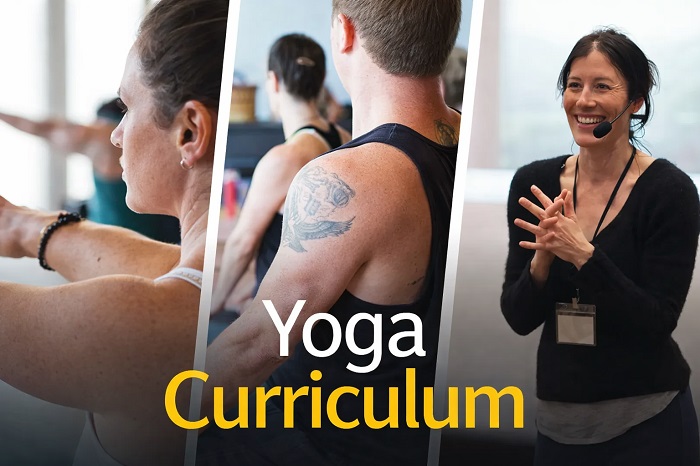
Summary: The yoga curriculum for your 200 or 300 hour teacher training needs to provide your students with a structured framework for learning. While a 200-hour should touch on a wide range of subjects to give your students a foundation in core competencies, a 300-hour may be more tailored to your unique studio’s brand and teaching.
Whether it’s a 200 or 300 hour yoga program, a well-designed yoga curriculum will cover essential teaching elements such as cuing, sequencing, teaching presence, and classroom management. Other subjects may include pranayama, meditation, yoga philosophy and history, and ethics/professional development modules to support your trainees to build sustainable and impactful careers.
A yoga curriculum is a combination of learning elements that all serve your intended learning outcome: detailed lesson plans (to outline activities, lectures, discussions, etc. with estimated timings and answer keys), a student manual, and assessments. Particularly for such robust programs as teacher training, your lesson plans need to be exceptionally well-organized so that you can guide your students progressively through developing their teaching skill across a range of subjects. Guidance from a yoga education expert can help ensure that you are laying the optimal foundation for your program.
Let’s take a look at some of the core components of an effective yoga curriculum.
The most important skill that you will teach your trainees is how to cue their own students safely, clearly, and effectively. Your training will be best served if you take some time to outline your training’s teaching methodology. A teaching methodology is a step by step process through which you teach your students how to teach. What should they look for when they observe their students? Where do they start when cueing? Where do they start? Your teaching methodology may include skills such as teaching the foundation, using direct language, cueing actions, cueing transitions, and verbal assists.
Your teaching methodology will be a hallmark of your training and ultimately will be part of your training’s branding and unique selling features.
Sequencing teaches your trainees how to structure yoga classes logically and safely. For a 200 hour curriculum, I encourage trainers to consider teaching using peak pose methodology. While this isn’t the only way to sequence a class, it provides an excellent launch pad for understanding asana, alignment, and anatomy. In this style, sequences gradually prepare the body for a complex posture. Trainees learn how to think critically and intentionally about their sequences.
Beyond cueing, you will want to consider what other teaching skills will be important to your curriculum. You may consider what skills your ideal graduate will possess. They may include verbal assists, physical demonstrations, hands on assists, use of props, and adaptations and modifications. Another key component of a structured YTT curriculum is creating the right learning environment for yoga. This component focuses on safety considerations, classroom setup, use of props, and studio atmosphere. All of these combine to create an inclusive space that supports an intentional experience for your students.
Since Covid, working online has become increasingly useful. You may consider including modules in your YTT that will teach your trainees how to navigate online platforms, editing and online recording best practices. Providing your trainees with skills in online offerings can support them to develop multiple avenues of revenue and sustainability once they graduate.
I am a huge proponent of providing students with a robust appreciation of the yoga tradition and its history. Through appreciating the lineage of yoga, students move out of perceiving yoga as mere postural calisthenics and can begin to engage with the deeper teachings of the lineage. Including studies in yoga history, the Sutra of Patanjali, the Bhagavad Gita, the Tantras or the Hatha Yoga Pradipika can be mind opening and plant seeds in your students for further study.
A professional yoga curriculum also prepares yoga teachers and teacher trainers for real-world careers. Defining a teaching mission, understanding branding, yoga business, liability considerations, ethical behavior, and marketing skills are great topics for professional development and will set your students on track for developing a sustainable business.
A well-structured yoga curriculum provides the foundation for effective teaching and meaningful learning that will support your trainees to realize their potential. Also, remember that your graduates are ambassadors of the experience and will be representatives of your program out there in the world! By taking the time to develop a comprehensive and thoughtful yoga curriculum, you are investing in your brand and business as well as your community.

Rachel supports yoga teachers and studios around the world to create transformational education experiences that help them thrive in their business, share their passion, and inspire more people to practice yoga. Her extensive knowledge and experience include: earning two masters degrees, authoring three books, leading 4,000+ hours of TT, building a teacher training college for a national yoga company, and working behind the scenes in yoga studio & teacher management for more than fifteen years. As a writer and speaker, she continually wrestles with the juicy bits of life: relationships, authenticity, and discovering meaning in this crazy, wildish world. E-RYT 500, YACEP, BA, MFA, MSci. Learn more about Rachel.


Leave a Reply