
|

Summary: A specialised software helps your yoga studio to manage scheduling, memberships, payments, and communication more efficiently. Choosing the right platform starts with understanding your business model and selecting tools that fit your services. A good system should prioritise user experience, offer reliable customer support and onboarding, and provide scalability with strong integration options. With the right software, your yoga studio can streamline operations, support long-term business growth, and improve client satisfaction.
——————————————
Running a yoga studio – or your own individual online teaching platform – is no small feat. A lot happens behind the scenes, including managing memberships, class schedules, payments, client communication, staff and teacher coordination (not to mention navigating all those sub requests!). Most yoga studio owners don’t start their business from an objective desire for profit; studios are founded because you want to create community, share your passion, and support others to practice. While passion may lead to the founding of a studio, it takes some robust processes and support to keep the studio going strong.
Choosing the right platform for yoga studio software does more than just save your time. As the link between how you operate and engage with your community, choosing the right software is important when it comes to growing and sustaining your business. In this blog, we will explore some factors to consider while choosing the right software.
Yoga studios are different from traditional gyms and fitness centres. While gyms and fitness studios thrive on open memberships, yoga studios are usually supported by their group classes. Also, while gyms often work from general check ins, yoga studios primarily use class registrations. Yoga may have membership, but they also usually offer drop in passes. There is definitely some overlap here, but some management systems used by gyms (MINDBODY for example) are too cumbersome for a yoga studio looking to keep things simple and clean. When considering your solution, focus on what products will be essential for your business.
Here you go!
Every yoga studio is different. So you need to take the time to look at how your business is running. Consider whether you will offer in-person classes, online sessions, workshops, privates, retreats and/or teacher trainings. What kind of packages do you want to offer (memberships, packages, drop ins)? Will you offer room rental of your space, or let the studio be used in other ways? Do you want Zoom links sent out automatically for online classes, or will you manage any online offerings in a different way? Do you want your scheduling platform to also act as your website, or be a plug in? By mapping out your key business needs, you will ensure that your platform of choice can support your unique business model.
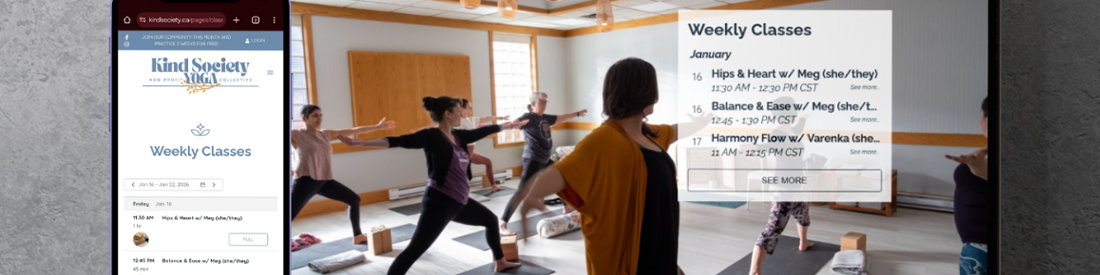
User-friendly software benefits both students and staff. If your team struggles to use the system, it will not matter how many neat features you have. Your clients should be able to book a class easily and your staff needs to be able to make schedule changes and manage registrations quickly. If you are a smaller studio, your teachers may occasionally be running sign in for you (rather than a dedicated support staff). Having a clear interface will make it easier for your team to book classes, manage memberships, cancel registrations, and access materials without confusion. Choosing the best yoga studio software to start your yoga business ensures better student engagement, smoother operations, and less time spent on administrative tasks.
To really know how your business is running, you need data. When you do a product demo with a software provider, make sure to ask about reporting functionality. Can the system give you a snapshot this year versus last? Can you easily see which packages are the most popular or which coupons are being redeemed? Can you easily track class registrations and numbers to see which timeslots are performing best? These key performance indicators will enable you to adjust your schedule and offerings to align with the needs of your community. Can the system track payroll for you? Consider all the metrics that will serve your ability to manage your studio properly and ensure that you can access this information easily.
In the world of rapid tech tech advancement, responsive support makes all the difference. Choose a provider that offers live chat, email, and phone support along with onboarding sessions. Good customer support is essential when adopting new technology. Reliable onboarding guidance helps you quickly learn how to manage payments, bookings, and class scheduling and to set up your site quickly.
To save time at the desk, you will likely want to connect waiver agreements to online class purchases. And if you are offering retreats or teacher trainings, you may want the option to create non-refundable deposits with tuition/refund agreements that students can sign online. Make sure to ask about this kind of functionality as you are vetting software systems.
Though you may only have one studio now, you may want to keep open the possibility that you will scale up and add more locations in the future. If growth is on your horizon, choose a platform that will allow you to transition to multi-locations with ease. Consider that you may want your platform to easily integrate with your website, accounting software, and marketing tools. Remember, for success, flexibility and future-proofing matter a lot. If you are running teacher training programs, then having organised digital sources (such as lesson plans) can also help to streamline training programs and maintain consistency in course delivery.
Using the optimal yoga studio software can help you to streamline daily operations from bookings and class scheduling to payments and member management. As a studio owner, by choosing the right platform, you can save time, improve your customers’ experience, and support your staff to manage their tasks with greater ease. The right software can support you to focus more on teaching and growing your community while running your business efficiently.

Rachel supports yoga teachers and studios around the world to create transformational education experiences that help them thrive in their business, share their passion, and inspire more people to practice yoga. Her extensive knowledge and experience include: earning two masters degrees, authoring three books, leading 4,000+ hours of TT, building a teacher training college for a national yoga company, and working behind the scenes in yoga studio & teacher management for more than fifteen years. As a writer and speaker, she continually wrestles with the juicy bits of life: relationships, authenticity, and discovering meaning in this crazy, wildish world. E-RYT 500, YACEP, BA, MFA, MSci. Learn more about Rachel.


Leave a Reply