
|
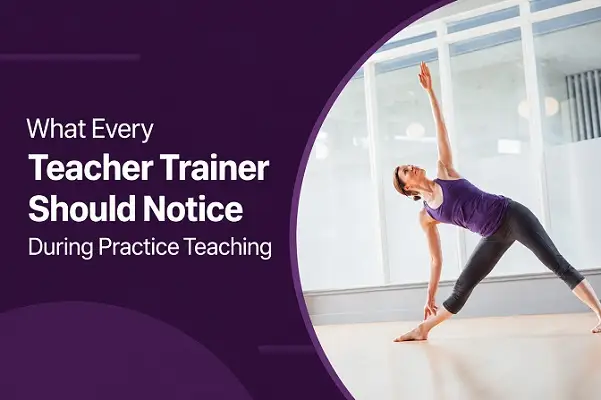
Summary: Practice teaching is an essential part of the teacher training process and provides critical feedback for students during their learning process. A trainer’s ability to give effective feedback can make the difference between a trainee’s success or failure.
Practice teaching – and feedback – are an essential part of any effective yoga teacher training. For a YTT to best support its participants, we – as trainers – must cultivate skills in observation, communication and leadership.
My name is Rachel Scott and I am an instructional designer and yoga teacher training who supports teachers and studios to create excellent trainings. If you are leading a YTT, here are the things that I would encourage you to watch for during practice teaching.
Before a trainee even speaks a word, they are communicating volumes to their students. Body language, pacing, posture, and affect immediately tell a story. Is the teacher nervous? Shy? Confident?
When we’re anxious, it usually translates into contracted body language. And we can see this in our students when they try to “hide in plain sight” by demoing too much, crossing their arms, or hiding out in the corners of the room. By (gently!) bringing awareness to our trainee’s body language, you can help shed light on their unconscious habits and help them to develop an open and warm aspect – even when they may feel a little nervous.
Some of your trainees may have never practiced public speaking before and -in fact – this may be the most challenging aspect of the program for them! Start slow and simply encourage your trainees to be audible. Over the course of the training, you can help coach them to develop more awareness of how their vocal tone, pacing, and inflection can contribute to the class experience.
One of the most important parts of teaching is cueing. However, it’s important to start with simple feedback for your trainees and work slowly over the course of the program towards more complexity. At first, simply help students to speak using direct language that is clear and concise. Help them notice and dissolve crutch language (such as “ah, um, now we’re gonna, good”) and speak with intention. Over the course of your program, you can layer in cueing tools that have more complexity.
In practice teaching, it can often be helpful to (kindly and gently) interrupt your students as they are teaching so that they can fix sub-optimal language on the fly and lay in more effective speech patterns.
As trainers, we often focus immediately on what needs to be “fixed.” Because we want to support our trainees, we can either only see what needs improvement or we can give too much information. It’s a great tool to “see the good first.” Your positive feedback is just as important as your critical feedback. By recognizing what your trainees are doing right before we move onto refinements, you set a foundation for them to build upon. Now, this is different than the proverbial s**t sandwich where you contain the “real” feedback between two pieces of happy bread! It’s important that we truly observe, validate, and communicate where we see success, even if it’s something as simple as, “You did a great job not crossing your arms during that section, even though you were nervous!” The little pieces will build over time.
As a trainer, one of our key responsibilities is to create a space where trainees can fail fast, fail fun, and fail with resilience. Set an environment from the beginning of your program that helps your participants to embrace a little mess, not take themselves so seriously, and be willing to jump into imperfection with a little zest.
I’m always happy to chat! If you want to discuss your program, book a free chat today.

Rachel supports yoga teachers and studios around the world to create transformational education experiences that help them thrive in their business, share their passion, and inspire more people to practice yoga. Her extensive knowledge and experience include: earning two masters degrees, authoring three books, leading 4,000+ hours of TT, building a teacher training college for a national yoga company, and working behind the scenes in yoga studio & teacher management for more than fifteen years. As a writer and speaker, she continually wrestles with the juicy bits of life: relationships, authenticity, and discovering meaning in this crazy, wildish world. E-RYT 500, YACEP, BA, MFA, MSci. Learn more about Rachel.


Leave a Reply