|
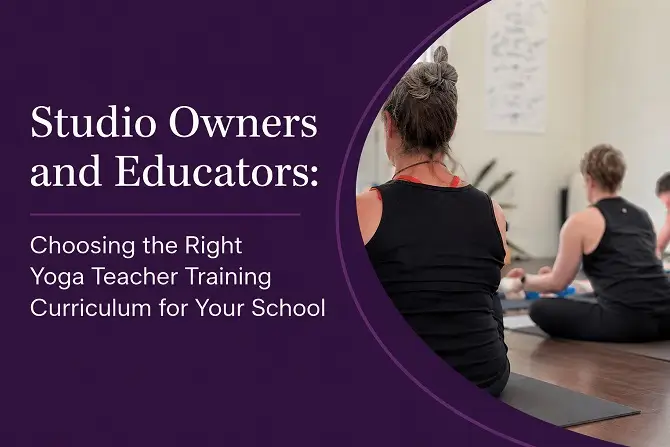
Summary: If you are a studio or a yoga educator looking to launch your own yoga teacher training and support your launch with pre-made resources, how do you choose the right ones? There are several yoga curricula out there, so which one will be the best investment for you? In this article, we’ll look at what you need to consider – and the questions you need to ask – to ensure you’re making a savvy investment.
All too often I have clients who come to me with the same story: I bought a training manual from someone, but I need to purchase another because it’s terribly organized. Or even worse: I invested in an expensive training program and it really misses the mark.
Choosing the right curriculum for your school can be really challenging. And since this curriculum is going to be the basis for the success of your yoga teacher training program, you want to do it right. A proper YTT curriculum needs to include far more than a student manual; it should also have robust lesson plans, assessments, visual presentations, and a clearly organized schedule. With different options out there, how do you know which curriculum is actually right for your school?
If you are a studio owner or yoga teacher trainer developing a new YTT program or updating an existing program, here are the things you should consider when creating and launching yoga teacher training:
Your yoga teacher training is more than another revenue line in your budget; your graduates are an extension of your brand and your studio’s reputation. Before you start comparing manuals and lesson plans, first ask:
Consider the skills, knowledge and attitudes that you want your graduates to have. The biggest mistake I see in curriculum shopping is not having a sense of your own teaching ideology and methodology before purchasing a program. However, your graduates will become an extension of your brand and ambassadors for your school. You want to ensure that the curriculum that you are purchasing is aligned to your own training style and mission – and that is has the quality and depth to help you create great teachers.
Consider:
Once you are clear about your goals, you can better evaluate whether a curriculum will actually support them.
I like to tell my clients: given all the time in the world, I’m sure that you could create an excellent YTT! And it’s true that creating a YTT curriculum from scratch can be incredibly rewarding. However: it can also take hundreds of hours. You will need to develop lesson plans, presentations, student manuals, assignments, assessments, activities, schedules, anatomy content, philosophy lessons, and practice-teaching structures. Then you need to make sure everything works together and it aligned with your registration organization of choice (like the American Council, Yoga Wheel or Yoga Alliance).
While it’s great to create your own program, you may save a lot of time and effort by off-loading some of the work and not reinventing the wheel. You might choose a complete curriculum, purchase individual lesson plans, use an editable student manual, or combine several resources with your own material. The result? You can focus on editing rather than building from scratch.
I hear this a lot from my clients, and frankly, I love this concern. Behind these words lies a rigorous work ethic, sense of integrity, and clear teaching mission. I get it, and I applaud the desire to build from scratch.
However, in the reality of the world – where you are running a studio, managing a family, teaching classes, and managing everything else – it can be helpful to have an “assistant” who has done some of the legwork for you. It would be “cheating” if you didn’t do your research to ensure you were getting the right curriculum for your program. Or if you didn’t take ownership of your materials and your students’ experience. But getting help with your curriculum build could make the difference between launching your training in six months or launching it in three years. Many of the trainers and schools that I have worked with have done the math and determined they’d rather spend their time editing/adapting/refining a high-quality program that aligns with their vision – rather than building everything from scratch.
A student manual can be an excellent resource. But a manual is not the same thing as a curriculum. While purchasing a manual may seem like a great investment, it still doesn’t help you to schedule, manage and plan the 200+ hours you have with your students in the classroom. For that, you need a proper curriculum and lesson plans.
When evaluating a YTT curriculum, look for:
You want to know how your students will learn and how they will practice, apply, and demonstrate that learning. A good curriculum should help you move from information to application.
Even the most comprehensive curriculum may not be the right curriculum for your school. In order to be worth your investment, the program materials should fit your teaching philosophy and your yoga style.
And even then, you need the flexibility to adapt the training and make it your own. Ask:
Your teacher training program should grow with you and have the breathing room to evolve over time. If you are purchasing a ready-made curriculum, ensure that you are able to customize the training and make it your own. The goal in purchasing a program is to have support for your own teaching vision; not to be boxed into someone else’s structure.
Ah, AI! In our latest AI craze it’s tempting to dump a training request into Chat GPT and see what comes back! While AI can be a great help in developing a curriculum (and it can be a fantastic assistant), it is no substitute for a designer who has created a curriculum that has been tried and tested in the classroom. AI is just not great at designing teaching methodology, vetting student activities, or structuring lessons that scaffold support across multiple topics. Look for a human-designed and vetted curriculum to ensure that you are investing in a program that works in real time with real people.
Excellent and impassioned faculty are critical for your program. However, sometimes multiple teachers can create problems when faculty have strong teaching opinions or may not be used to managing their time and topics. Particularly in a 200-hour, you don’t want faculty contradicting each other or missing material. A strong curriculum can help faculty anchor their teaching in a common foundation (and a common language), which will create a more unified experience for your students. Also, an organized training structure can help faculty stay organized, cover required topics, and stay up to date on what each one is doing.
Your faculty will still bring their own experience, personality, and expertise to the training. But a strong and well-organized curriculum will help everyone understand their role in the larger program.
Choosing the right YTT is not about finding the biggest manual or cheapest price. You need to find a curriculum with the right structure, resources, and support for your training. You should not have to spend all of your time reinventing every lesson plan, assignment, and student resource. Instead, you want to invest in a curriculum that will free you to spend your time on minor adaptations and the other tasks that go into a program launch.
If you’re building your YTT or looking to upgrade the existing one, you are welcome to book a free chat with me. I am happy to help you figure out your next step.

Rachel supports yoga teachers and studios around the world to create transformational education experiences that help them thrive in their business, share their passion, and inspire more people to practice yoga. Her extensive knowledge and experience include: earning two masters degrees, authoring three books, leading 4,000+ hours of TT, building a teacher training college for a national yoga company, and working behind the scenes in yoga studio & teacher management for more than fifteen years. As a writer and speaker, she continually wrestles with the juicy bits of life: relationships, authenticity, and discovering meaning in this crazy, wildish world. E-RYT 500, YACEP, BA, MFA, MSci. Learn more about Rachel.



Leave a Reply