
|
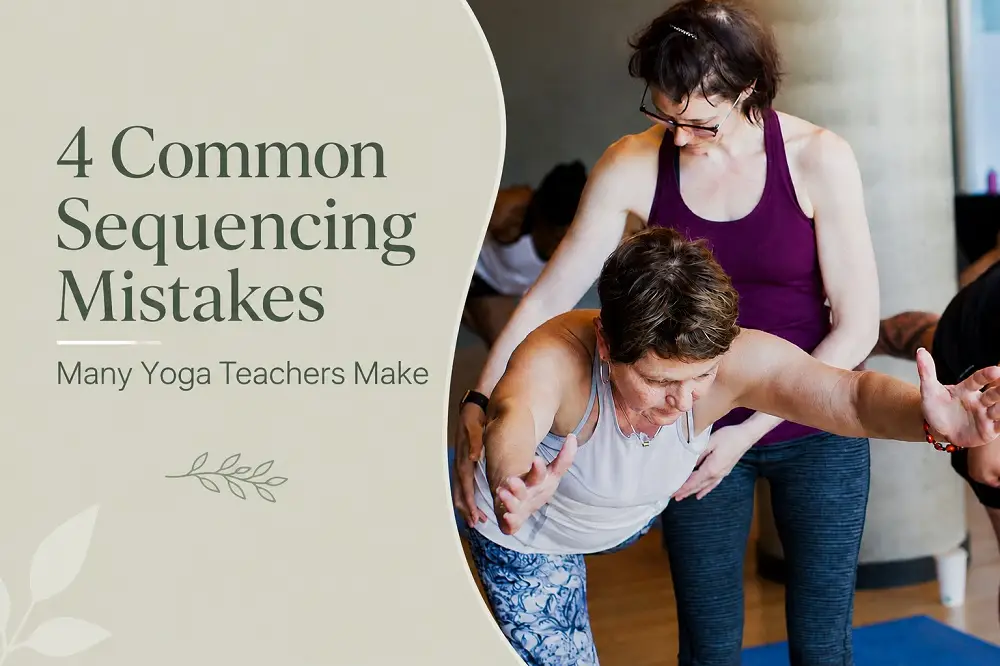
Summary: Sequencing includes more than just the order of the postures. Common yoga sequencing mistakes include not accounting for the time of day, opening before engaging, failing to teach, and falling into the entertainment trap.
Imagine this: your students walk into your yoga studio after a long, hectic day. Their nervous systems are wired, their bodies are tight, and they’ve been sitting at a desk all day. You start class with a long pranayama practice, hoping to help them transition into the juicy smooth experience practice. However, they just get more antsy..and even frustrated.
Although arranging postures in an order is of course the foundation of yoga sequencing, we need to account for more than just pose order when we plan our classes. In your 200-hour yoga teacher training, you likely learned the basic principles of the yoga sequencing, but there are some additional considerations that can make a huge difference in the class experience. Let’s take a look.
A class at 6 AM must be sequenced differently from a class at 6 PM. At 6 AM, you can turn the lights low, start students slowly with intuitive movement, and then gradually build the class intensity. At the end of the class, you want to leave your students engaged, alert, and ready for the day. Contrast this with a class at 6 PM. Your students arrive wired and frazzled. They need to get moving quickly and with some power to “work out their ya-ya’s” and then have time for a slower unwind. By adapting your sequence to account for the time of day, you will ensure that your sequence meets students where they are at.
In general, yoga fosters mobility. We have lots of postures that encourage muscle lengthening and joint range. One trap that we can fall into is introducing “opening” postures too quickly in our sequence. I like say, “engage before you open.” This simply means that we want to work muscles before we move into poses that challenge their range of motion. (And I would argue that mobility work in yoga is best combined with “range under tension” rather than passive stretching.) What this means is that we want to work the quads (like in warrior 2) before we do a quad stretch (say in dancer’s pose), and engage the spinal extensors (for example, in locust pose) before we add in outside leverage to move deeper (for example, as in bow). This is a pretty obvious principle, but a useful one to keep in mind. It also means that we don’t want to “throw in” postures without preparation. As a teacher, you need to maintain yoga sequencing principles. Start with simple poses, build in complexity. Transition smartly.
Renowned teacher Leslie Kaminoff made a great distinction between “leading a class” and “teaching a class.” Leading a class is where we facilitate a guided experience of the postures; we teach students WHAT to do. Teaching a class is different; we instruct students on HOW to do the postures. Most new teachers will lead classes rather than teach them. This includes what I can “failing to teach.” What I mean is that it can be tempting to throw in advanced postures without teaching them. For an all levels class, I prefer to refrain from phrases like, “if it’s part of your practice…” To create an inclusive class experience, give options so that everyone can participate in the pose experience. (As a note, for an advanced class, I may make an exception to this guideline given the capacity of the students). When you plan your sequence, consider not just the pose but the stages of the pose that you can include. , I consider what stages of the poses I can offer to accommodate all the students in the room.
Do you feel the need to entertain your students? Do you feel compelled to create new and interesting flows for each class so that they don’t get bored? If so, you may be falling into the “entertainment trap.”
Yoga is not Netflix; it doesn’t have to entertain. True: your bold and exotic sequence may help give students something to focus on, but eventually part of the practice is creating a container where students actually have to deal with their own mind hamsters.
If your passion is creating wild flows, then wonderful! However, novelty is not a requirement for a safe, powerful and transformational class experience. Some of the most powerful yoga styles use set sequences that are the same every time. Focus on the quality of your sequence – not the entertainment value. If that feels scary, I would encourage you to teach the same sequence for a couple of weeks and discover the power of depth (rather than breadth).
To raise the level of your teaching, set an intention to develop your capacity to “teach” rather than “lead.” When you plan your classes, consider the time of day, create inclusive stages for complex postures, and notice if you feel the pressure to entertain rather than teach. Incorporating these considerations can help take your sequencing and teaching to a new level! Enjoy ~

Rachel supports yoga teachers and studios around the world to create transformational education experiences that help them thrive in their business, share their passion, and inspire more people to practice yoga. Her extensive knowledge and experience include: earning two masters degrees, authoring three books, leading 4,000+ hours of TT, building a teacher training college for a national yoga company, and working behind the scenes in yoga studio & teacher management for more than fifteen years. As a writer and speaker, she continually wrestles with the juicy bits of life: relationships, authenticity, and discovering meaning in this crazy, wildish world. E-RYT 500, YACEP, BA, MFA, MSci. Learn more about Rachel.


Leave a Reply