
|
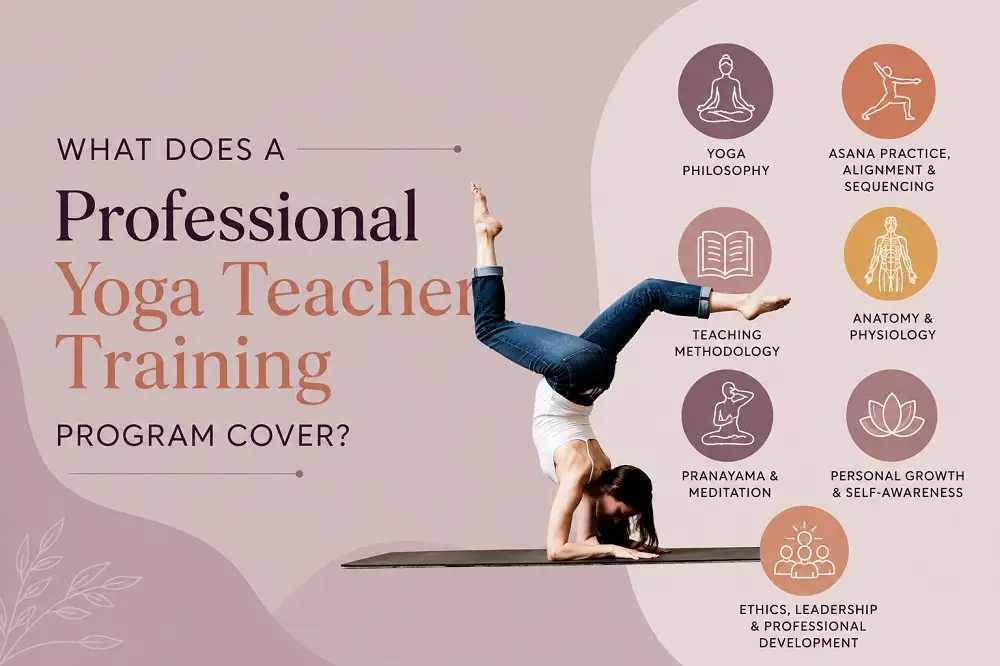
Summary: To be effective, a yoga teacher training program should cover essential foundational content ~ without being overwhelming.
Are you creating a yoga teacher training and wondering what to include? Some folks think that teacher training is only about the physical aspect of the practice: postures, alignment, and sequencing. However, I would propose that a comprehensive program covers far more than physical movement; it will help your students understand their place in their tradition, grow their confidence and step into leadership. A well-designed training is about more than yoga; it can help your trainees cultivate self-awareness, mindfulness, and resilience.
In North America, the physical aspect of your teacher training will generally dominate. Helping students understand asana, alignment, and sequencing will be essential in your teacher training. By the end of their journey, students should understand the purpose of their posture, its relationship to other postures, key alignment principles, common misalignments, sequencing considerations, and adaptations. If developing your own program from scratch sounds intimidating, you may consider investing in a Yoga Teacher Training Curriculum to help you get started. I’m also a big fan of including sequencing in your 200 hour program. Rather than provide set sequences, I suggest teaching your trainees principles of sequencing (that relate to their study of asana) so that they are empowered to create smart, safe classes.
A professional yoga teacher training program should help trainees connect with the deeper roots of yoga beyond the physical practice. Including the study of texts such as The Yoga Sutra of Patanjali and The Bhagavad Gita can help give context to the physical practice and help students cultivate a personal connection with this vast lineage. The study of key texts can also provide a powerful launching pad for discussions of ethics and professional behavior. When teaching these topics, refrain from too much lecture. Instead, create lots of space for discussion, inquiry, contemplation, and application to personal life, as this can be one of the most transformational parts of the training experience.
I know that I’m an anatomy nerd, but I do believe that anatomy education is an important part of the teacher training experience. After all, since we work so much with the physical body as teachers, it’s important to have a general understanding of how it works! New to Anatomy? Never fear! You can buy Anatomy & Physiology Lesson Plans to support your own knowledge as well as help you teach these topics with ease and confidence. A good anatomy program should teach about structures, but also apply anatomical information to postures to help students recognize common misalignments, appreciate human variation, and adapt postures sensibly.
Teaching methodology is where you help students develop skills so that they can become an effective instructor. This includes practical skillbuilding in areas of cuing, sequencing, assists, classroom management, demonstrations and “holding space.” This portion of a YTT can be tricky for new trainers to develop as it requires a bit of metacognition to create systems around these skills. In other words, you must think about how you are going to teach these skills systematically and logically so they make sense to your students. This portion of the YTT is the “how” behind teaching. When scheduling these lessons, allow plenty of time to have students practice teach and receive feedback. This part of the program is where your trainees really learn how to teach.
As you develop your curriculum, I would encourage you to create a program that balances our modern passion for asana with the wisdom of the tradition. Make sure that you create a structured teaching methodology to simplify and clarify a process for starting to teach. Also, it’s important to remember that students are not just learning content; they are also usually challenging themselves and stepping out of their comfort zone. Many students come to yoga teacher training when they are in a life transition and making big changes. Participating in a YTT is a powerful opportunity for trainees to not only deepen their knowledge and skills, but grow personally as well.

Rachel supports yoga teachers and studios around the world to create transformational education experiences that help them thrive in their business, share their passion, and inspire more people to practice yoga. Her extensive knowledge and experience include: earning two masters degrees, authoring three books, leading 4,000+ hours of TT, building a teacher training college for a national yoga company, and working behind the scenes in yoga studio & teacher management for more than fifteen years. As a writer and speaker, she continually wrestles with the juicy bits of life: relationships, authenticity, and discovering meaning in this crazy, wildish world. E-RYT 500, YACEP, BA, MFA, MSci. Learn more about Rachel.


Leave a Reply