
|
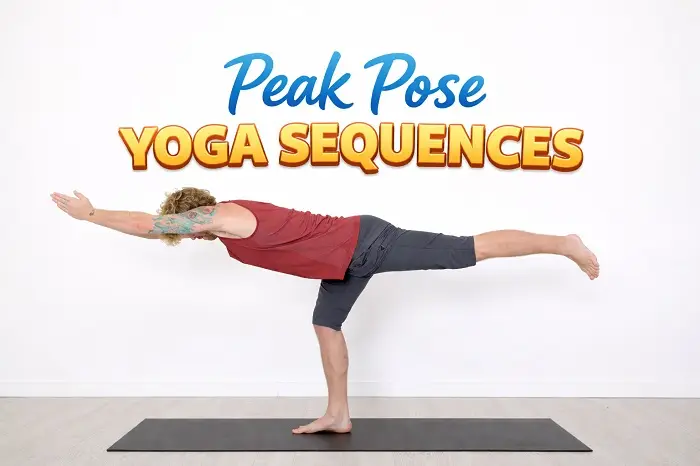
Summary: Peak pose sequences don’t need to be complicated to be effective. Overloading trainees with too much complexity can be confusing, while teaching simple, well-organized sequences will build your trainees’ understanding and confidence. When students understand how sequences are built, they can think critically about sequence creation rather than simply copy them.
If you are building your first yoga teacher training, you may feel like you need to create impressive peak pose yoga sequences for your trainees. After all, aren’t they paying to “deepen” their personal practice? As trainers, we often feel the pressure to “wow” and entertain our students with complex poses and creative transitions rather than sticking to the basic nuts and bolts of practice.
While exotic sequencing may have some entertainment value in your public studio classes (though this is also debatable), overly complex sequencing will work against us in teacher trainings. Your students don’t need complex sequences; they need logical, structured practices that obviously showcase the process of peak pose sequencing.
Hello, I’m Rachel Scott, a yoga educational consultant. In this blog, I will discuss why simple peak poses sequences are essential for your teacher training.
1. More Isn’t Always Better: When we start teaching teachers, it can be tempting to share everything we know. We can overcomplicate our sequences with too many postures and transitions. However, too much “noise” in the sequences makes it hard for your trainees to recognize peak pose sequencing logic clearly. Rather than overloading your sequences, focus on using simple postures that create an obvious and clear progression to your peak pose.
2. It Creates Confusion: Let’s be honest: when we teach public classes, we can sometimes get rewarded when we develop creative and “entertaining” sequences. (Our students love the distraction!) However, ornate sequences are not great for teacher training, where we want to lay bare the principles of sequencing with utter clarity. As a teacher trainer, your job is not to entertain: your job is to help aspiring yoga teachers clearly understand the mechanics and principles of peak pose sequencing.
1. Repetition Builds Understanding: Simple sequences repeat key actions, which helps your students to recognize how poses within the same “family” are related. For example, when you’re teaching a sequence to half moon, you’ll want to clearly teach hip external rotation in warrior 2, triangle pose, and side angle pose first to highlight their similarities. This repetition helps your students to experience and embody the postures rather than memorize alignment points.
2. Clarity Creates Confidence: When sequences are simple, your students can learn to replicate and teach them more confidently and easily. When students understand the logic of the sequence, they understand why each pose is included rather than worrying about memorizing a long list of postures. When a sequence is anchored in a clear intention, the yoga sequence itself is a creative experience where all elements of the sequence work towards the same goal.
1. Identify the Component Parts of the Peak Pose: Begin by breaking the peak pose into its component parts and determining what needs to be warmed up or educated to do the peak pose safely. Identifying the component parts is the foundation of good peak pose sequencing.
2. Brainstorm Poses That Train Those Actions: Next, choose poses that help to warm up the component parts effectively. Keep it simple; we don’t need to be exotic. Choose foundational yoga postures that support the actions needed safely and clearly. You need a few that clearly train the body.
3. Keep the Sequence Simple.
4. Move From Simple to Complex. Begin with simpler postures at the beginning of class. As you move through your sequence, integrate more complex postures that integrate multiple component parts at once. By the time you get to the peak pose, your student will be able to recognize how everything they’ve practiced supports the peak pose.
1. Teach the “Why,” Not Just the “What”: In a public class, we teach and the students follow. However, in teacher training, our students need to understand. We are not just leading; we are educating. It’s okay for sequences to be slower and more “workshoppy.” When you teach, help draw the connections for them between the postures and component parts.
2. Get Students to Break Down Sequences:
After the practice, take time to debrief the sequences with your trainees. Ask students to think critically:
· What is the peak pose?
· What are its component parts?
· Which poses helped educate component parts for the peak pose.
3. Let Them Build Their Own Sequences: Students learn by doing. Once you’ve established peak pose sequencing principles, task students with creating sequences and give them specific feedback on their work. I like to start by having students work in groups for peer support and ultimately turn in a sequence that they have created on their own. Your feedback throughout this process is critical. Some students will overcomplicate their sequences here; help them focus on staying simple and effective.
4. Focus on Foundational Teaching Skills, Not Exotic Performance: When they graduate from your program, your students don’t need to craft elaborate masterpieces; they need to teach a logical sequencing progression with clarity. Empowering your students to sequence simply will help them gain confidence. Rather than memorizing a bunch of postures and transitions, they will be taking their students on an intentional journey.
You don’t need complicated yoga sequences to train great teachers. In fact, simple sequences enhance your students’ ability to learn. By prioritising simplicity over complexity, you will help your students gain a strong foundation in sequencing principles and class design. You can buy a 200-hour lesson plan or explore my blogs to learn more about yoga sequencing.

Rachel supports yoga teachers and studios around the world to create transformational education experiences that help them thrive in their business, share their passion, and inspire more people to practice yoga. Her extensive knowledge and experience include: earning two masters degrees, authoring three books, leading 4,000+ hours of TT, building a teacher training college for a national yoga company, and working behind the scenes in yoga studio & teacher management for more than fifteen years. As a writer and speaker, she continually wrestles with the juicy bits of life: relationships, authenticity, and discovering meaning in this crazy, wildish world. E-RYT 500, YACEP, BA, MFA, MSci. Learn more about Rachel.

Leave a Reply