
|
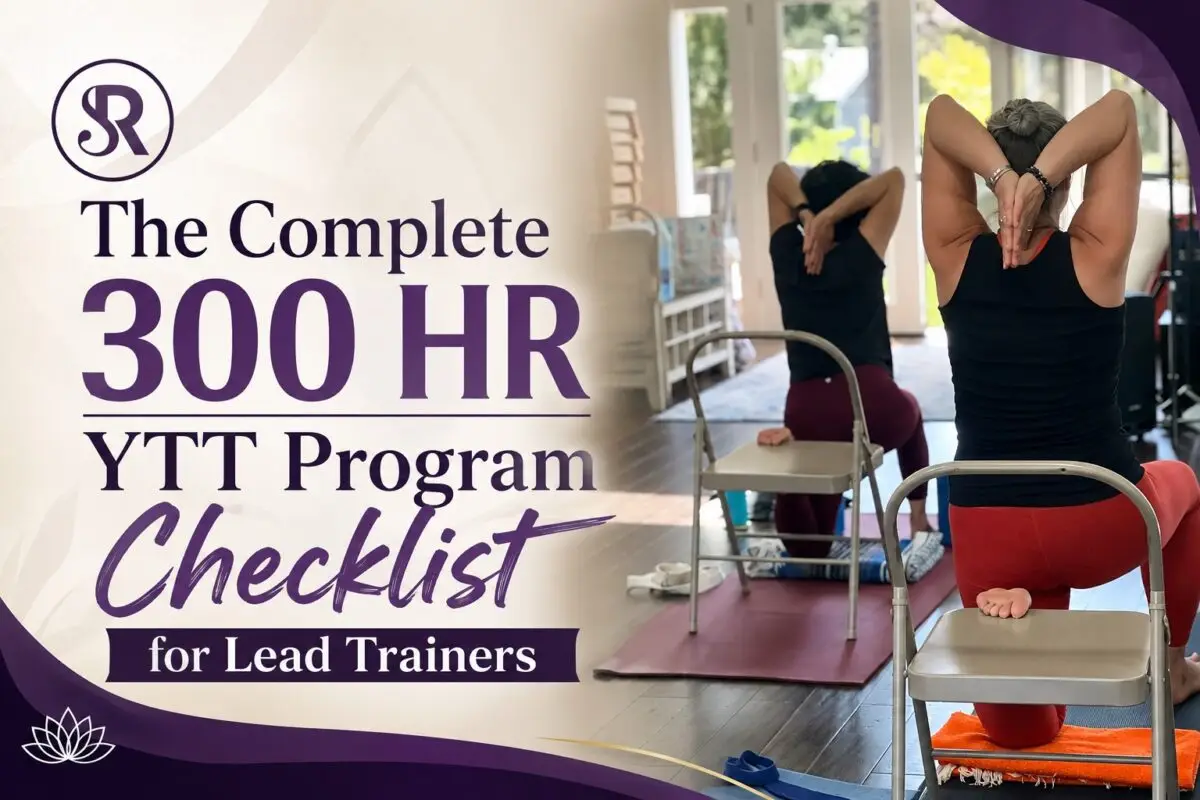
Summary: A successful 300-hour Yoga Teacher Training program requires clear learning outcomes, mentorship, professional skillbuilding and leadership development.
You have offered a 200 hour yoga teacher training and are ready to offer an advanced training. Students are asking for more advanced training and you are ready to step up.
However, creating a 300-hour teacher training curriculum is not just about adding more hours to a 200-hour YTT program. A 300-hour program has a different intention and trajectory. Where a 200 hour program may be taken up by aspiring teachers and curious students alike, a 300-hour program is a container that supports the development of yoga professionals.
If you’re developing a new training or improving an existing one, this checklist will help you create a 300-hour program effectively.
As with any effective educational experience, before you start designing lesson plans or writing manuals, it’s important to define what your trainees can achieve by the end of the program. Taking the time to write measurable learning objectives will help you clarify the goals and vision for your advanced training. Unlike a 200-hour (where there is more general overlap of teaching content), a 300-hour program is an opportunity for you to clearly articulate your school’s mission in the world. Does your program focus on skillbuilding for group classes? Developing classes for special populations? Understanding and working with the subtle body? Excellent theming? When crafting your learning objectives, you are clarifying and articulating how your School sets itself apart. These learning objectives will also give prospective students insight as to whether or not they align with your school’s vision and values.
A 300-hour program develops and nurtures yoga professionals who intend to make teaching yoga a substantial part of their lives and identity. Incorporate mentorship opportunities into your program (through having your trainees assist classes, work 1-1 with advanced faculty, teach under supervision) will help them develop the professional skills they need to succeed. In a 200-hour YTT, we are really just trying to get our students to teach a safe class; in a 300-hour program, it is time to nurture each trainee’s unique gifts and authentic teaching voice. Mentorship will be essential to help your trainees reach their potential.
While our 200-hour graduates are really just finding their feet as teachers, your 300-hour graduates need to be skillful, confident, and professional instructors by graduation. In a 300-hour program, it is time to ensure that your trainees have mastery of their cuing and sequencing skills and possess an appropriate depth of knowledge in anatomy, philosophy and ethics. I’m personally not a huge fan of modular 300 hour YTT’s (where you put together various CE programs that students can take a la carte and then have that create your 300-hour program). Though perhaps convenient for scheduling, a modular 300-hour abandons the opportunity to mentor students through the entire process and progressively build their foundational teaching skills.
Most 300-hour trainees intend to make yoga a part of their livelihood and lifestyle. As a school and educational leader, you have the opportunity to support your trainees to step into their voice and values as leaders. Being a professional yoga teacher is not a casual vocation; find opportunities in your training to support your trainees to step into their leadership and reflect upon their role as a steward of this tradition.
Creating a quality 300-hour YTT is a slightly different endeavour than creating a 200-hour YTT. Because a 300-hour YTT is a professional program, we need to take more care to ensure that our trainees emerge confident, poised, and ready to step into the seat of leadership. And remember: a 300-hour curriculum is an opportunity for you – as a school – to clearly define your program’s unique mission and intent. More than in a 200-hour, your graduates will be seen as a direct reflection of your school’s efficacy. By crafting an high-quality educational experience, you will both enhance your school’s reputation while supporting your graduates to shine.

Rachel supports yoga teachers and studios around the world to create transformational education experiences that help them thrive in their business, share their passion, and inspire more people to practice yoga. Her extensive knowledge and experience include: earning two masters degrees, authoring three books, leading 4,000+ hours of TT, building a teacher training college for a national yoga company, and working behind the scenes in yoga studio & teacher management for more than fifteen years. As a writer and speaker, she continually wrestles with the juicy bits of life: relationships, authenticity, and discovering meaning in this crazy, wildish world. E-RYT 500, YACEP, BA, MFA, MSci. Learn more about Rachel.





Leave a Reply